Cortical Organization of Metabolic Connectivity (fPET-FDG)
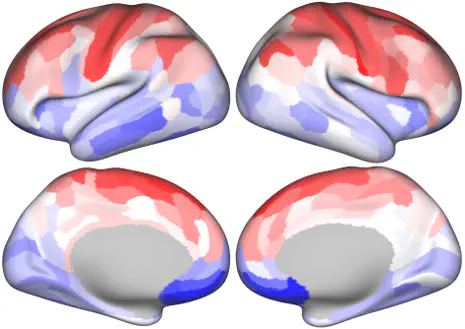
Functional PET-FDG (fPET-FDG) makes it possible to track glucose metabolism dynamically. This raises the question of whether metabolism shows a connectivity structure analogous to the functional connectivity measured with fMRI, and what such a structure would mean.
Using resting-state fPET-FDG data from 24 individuals, I characterized local metabolic organization with connectivity-based boundary mapping (adapted for the low SNR of fPET-FDG), and global organization with community detection and principal gradient analyses.
Key results
- Locally, boundary mapping revealed structured transitions shaped by both fast and slow fPET-FDG signals, partly overlapping fMRI functional connectivity boundaries.
- Globally, metabolic connectivity was organized along a robust superior–inferior cortical gradient, consistent across community detection and gradient analyses.
- This gradient was primarily driven by low-frequency, minute-scale fPET-FDG dynamics, and aligned closely with known anatomical and energetic constraints.
Published in European Journal of Nuclear Medicine and Molecular Imaging (10.1007/s00259-026-08109-5). Carried out at the Martinos Center for Biomedical Imaging, Harvard Medical School, supervised by Prof. Jingyuan Chen.

Penghui Du
MSc Neuro-X, EPFL · Visiting Graduate Student, Buckner Lab, Harvard
Neuro-X master’s student at EPFL and visiting graduate student in the Buckner Lab at Harvard, working on precision functional mapping and multimodal neuroimaging.